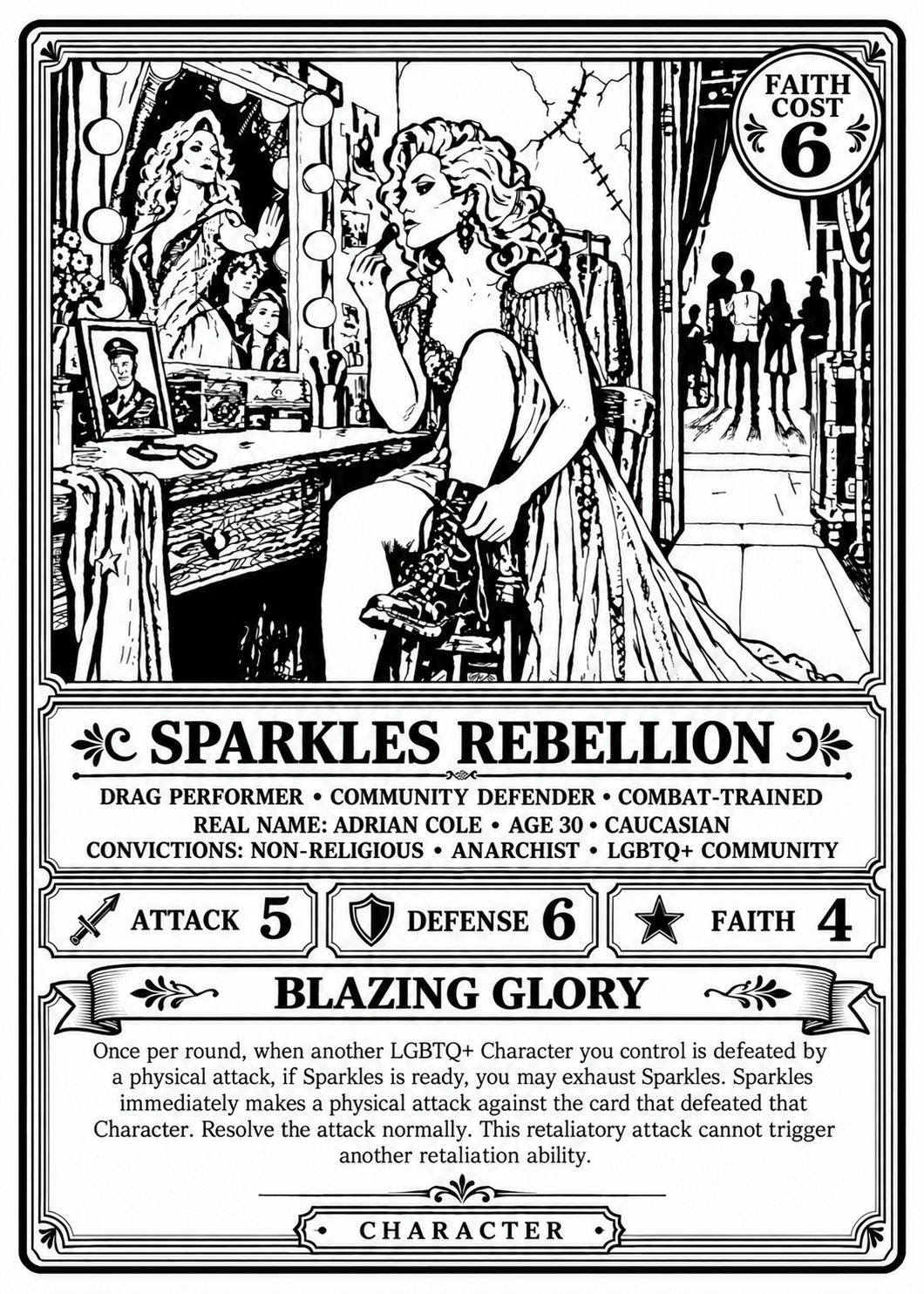
Complete character backstory
Before the spotlight.
Content noteThis fictional story includes family rejection, anti-LGBTQ+ violence against minors, severe physical assault, hospitalization, and lasting paralysis. It emphasizes loyalty, survival, chosen family, disciplined protection, and the dignity of drag performance.
Before the Spotlight
Before there was Sparkles Rebellion, there was Adrian Cole: a quiet boy who learned early that a home could be both shelter and trial. His parents were unable to care for him, so his uncle, Daniel Cole, took him in. Daniel was a retired Navy SEAL, a man shaped by order, discipline, and the belief that weakness invited danger.
Daniel gave Adrian a room, food, rules, and a place that would not disappear beneath him. He also made no secret of his discomfort when Adrian began to understand that he was gay. Their house was not openly cruel, but it was often painfully quiet. Daniel believed he was protecting his nephew by hardening him. Adrian understood that being allowed to stay was not the same as being fully seen.
Still, Adrian built a life wherever he could. At school he found friendship, music, and one boy who made him feel that honesty did not have to be dangerous. For the first time, he had someone beside whom he did not need to reduce himself.
The Day Loyalty Was Tested
Adrian was twelve when he saw his boyfriend surrounded by adults outside school. The words came first—accusations and slurs thrown at a child as though his existence were an offense. Then the adults began to strike him.
Adrian knew he could not overpower them. He knew that stepping forward would make him another target. He stepped forward anyway. He placed himself between the attackers and the boy he loved, held his ground for as long as his body allowed, and was beaten severely.
Both boys were taken to the hospital. Adrian survived with injuries that would eventually heal. His boyfriend survived too, but the attack left him paralyzed on the right side of his body. Adrian carried two truths out of that hospital: courage had not been enough to prevent terrible harm, and abandoning someone would have been a wound of its own.
When Daniel demanded to know what had happened, Adrian told him everything. He did not hide who the boy was or why he had intervened. He expected anger. Instead, the retired SEAL fell silent.
Daniel had spent years thinking Adrian’s sexuality was the part of him that needed correcting. What he heard that night was something he understood without translation: loyalty under fire. For the first time, Daniel looked at Adrian not as a problem to solve, but as someone whose character had already been tested.
Adrian told him, “I never want to be too weak to defend the people I love.” Daniel studied him for a long moment and answered, “I can help with that.”
Twelve Years of Training
The training began carefully. Daniel taught Adrian balance before power, awareness before aggression, and control before speed. He taught him how to fall, how to escape a hold, how to protect another person without losing sight of an exit, and how to recognize when the safest victory was getting everyone home.
As Adrian grew older, the work became harder. Daniel pushed him through exhaustion, but he also taught restraint. Skill was never permission to seek violence. A weapon was never a substitute for judgment. Strength mattered most when it created a path out of danger.
For twelve years, the lessons continued. Some were learned in a training room, some through silence, and some in the difficult space between a guardian’s old beliefs and a nephew’s refusal to live dishonestly. They did not solve every difference between them. But slowly, discipline became a language through which respect could travel.
The Birth of Sparkles Rebellion
Training taught Adrian how to occupy space. Drag taught him how to transform it.
At twenty-four, after twelve years of training, he entered the Lantern, a city nightclub known for giving new performers a chance. Backstage, under unforgiving mirror lights, a veteran drag artist named Rosetta showed him that makeup was not a mask for hiding. It was a language: contour could declare authority, a painted eye could hold an entire room, and a costume could turn survival into spectacle.
Adrian chose the stage name Sparkles because joy could be defiant. He added Rebellion because he refused to accept a world in which people like him were expected to become smaller in order to remain safe. Sparkles was feminine, commanding, funny when she wished to be, and impossible to ignore. She did not erase Adrian. She revealed the courage he had once expressed only in moments of danger.
Over the next six years, Sparkles became the Lantern’s main attraction. Her flame-patterned costumes, sculpted hair, and precise performances drew crowds, but the people backstage knew another side of her reputation. She walked younger performers to their cars. She watched for predatory patrons. She learned names, listened without judgment, and used Daniel’s lessons to de-escalate trouble before it became violence.
Daniel never became comfortable with every part of drag culture, and Adrian stopped requiring perfect understanding before accepting honest growth. His uncle attended one performance and stood awkwardly near the back. When the room rose for Sparkles, Daniel did too. Afterward he said only, “You held the whole room.” Adrian knew what the words had cost him, and what they meant.
Blazing Glory
One night, a young LGBTQ+ performer was attacked outside the Lantern. Sparkles saw her fall. For an instant, the alley became the schoolyard again: someone vulnerable on the ground, bystanders frozen, and danger demanding an answer.
Sparkles moved before fear could settle. She placed herself between the attacker and the fallen performer, redirected the next blow, and forced the attacker back long enough for others to pull the victim to safety. She did not chase vengeance down the street. Her purpose was protection, not punishment. But everyone watching understood the promise in her stance: harming one member of the community would not leave the rest standing alone.
The story spread through the neighborhood, and someone gave the moment a name that belonged equally to the stage and the street: Blazing Glory.
“You do not have to understand every part of me to understand this: I will not stand aside while someone I love is destroyed.”
For Sparkles, solidarity is not an abstract slogan. It is a decision made while there is still time to step forward. The twelve-year-old who once lacked the strength to stop an attack has become an adult who knows that protection is not measured only by whether harm occurred. It is measured by whether anyone was left to face it alone.