Complete character backstory
The life behind the card.
Content note
This fictional story includes a fatal residential fire, pregnancy loss, severe burn injuries, grief, and a non-graphic reference to a suicide attempt. The story emphasizes survival, treatment, community support, and recovery.
The Life Before the Fire
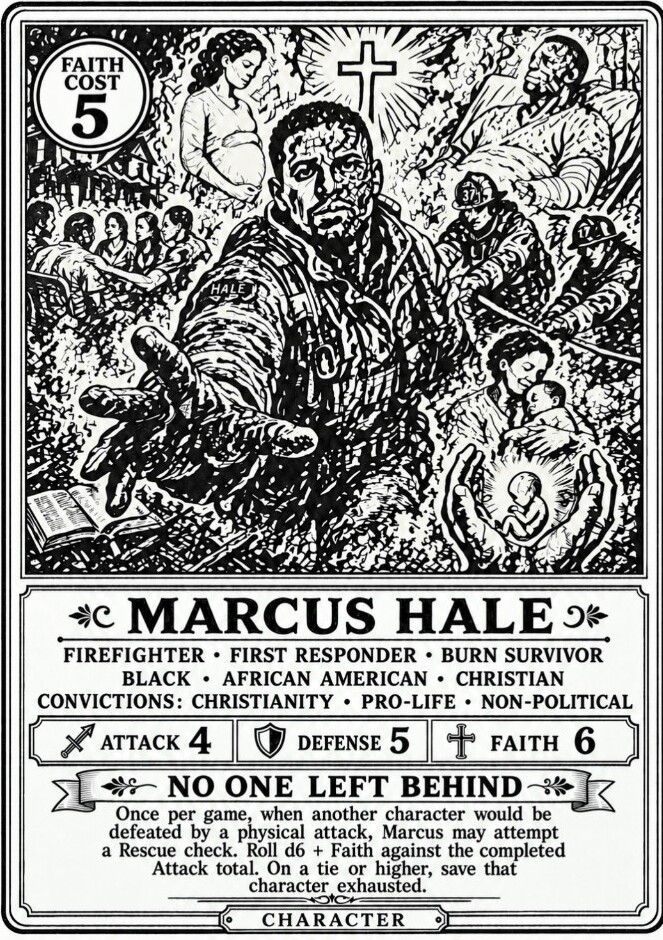
At twenty-two, Marcus Hale measured his life in small, practical plans. He worked the overnight shift stocking shelves at a grocery store, saving what he could from every paycheck. The job was exhausting, but he and his wife, Tessa, were preparing for their first child, and every box he lifted felt connected to the home they were building together.
Tessa was an assistant teacher at a neighborhood early-learning center. She was patient, quick to laugh, and incapable of walking past a child who felt left out. At home she filled a notebook with possible baby names, sketches for a nursery, and lists of things they could buy secondhand. Marcus teased her for planning years ahead. Secretly, those plans made him feel safe.
They did not have much money, but their apartment was warm, crowded with borrowed furniture, family photographs, and the ordinary evidence of two people expecting a future. Marcus believed their real life was just beginning.
The Night Everything Changed
Near the end of an overnight shift, Marcus received a call telling him there was an emergency at home. He drove back to a street filled with smoke, emergency lights, and neighbors standing behind the fire line. Flames had already broken through part of the roof.
Marcus searched the crowd for Tessa. He did not see her.
Firefighters were entering the building and trying to control the scene. Marcus was not trained, equipped, or thinking clearly. Driven by terror, he broke past the perimeter and entered the burning home. It was a desperate decision that nearly took another life and one he would later understand very differently as a firefighter.
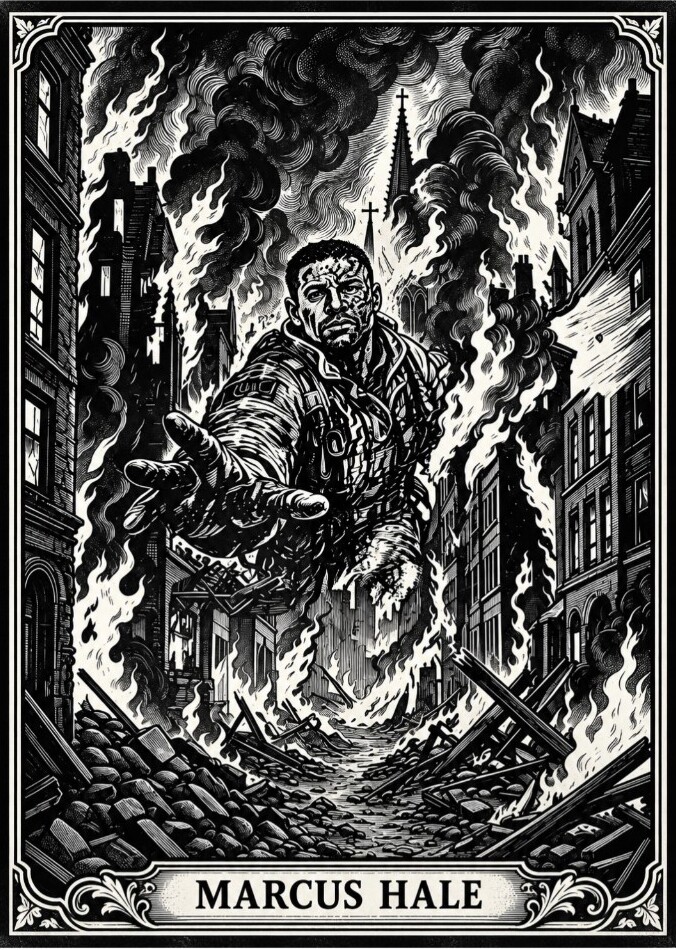
Inside, smoke erased the rooms he knew. Heat pressed through his clothes. He called Tessa’s name until he found her unconscious beyond the hallway. Marcus lifted her and began moving toward the front entrance. Burning debris struck him, and flames caught his clothing. Still holding Tessa, he reached the front of the house before his body gave out. The firefighters who had followed pulled them both from the doorway.
Marcus awakened in a hospital weeks later. He had sustained burns across more than sixty percent of his body, including extensive injuries to one side of his face. Tessa and their unborn child had not survived.
For a long time, Marcus could not accept that he had carried them so close to safety and still lost them. He replayed the final distance to the door until it became larger in his mind than the rest of the world.
Five Years of Healing
Recovery did not arrive as a single victory. It came through surgeries, skin grafts, physical therapy, painful movement, interrupted sleep, and the daily work of learning to live in a changed body. Mirrors became difficult. Strangers stared. Some people looked away too quickly, while others looked too long.
Tessa’s older sister, Camille, made sure Marcus’s grief did not erase Tessa herself. She brought photographs, stories from the classroom, and pages from Tessa’s planning notebook. Tessa was not merely the person Marcus had failed to save. She had been a teacher, a sister, a friend, and a woman who believed neglected people deserved to be noticed.
At his lowest point, Marcus attempted suicide. The attempt is not the moment that made him heroic; it was a medical and emotional crisis in which he needed immediate help. Emergency care kept him alive. In the months that followed, trauma counseling, a burn-survivor group, rehabilitation specialists, family members, and other survivors helped him begin rebuilding a life he no longer believed he deserved.
One of the firefighters who had pulled Marcus from the doorway visited without asking him to be inspirational. She told him the truth: rescuers do not control every outcome, courage does not cancel grief, and surviving does not create a debt that must be repaid through suffering.
Marcus slowly learned that accepting help was not weakness. His scars were not proof that he had failed Tessa. They were evidence that love had driven him into the fire, and that other people’s courage had carried him back out.
A New Calling
Marcus first returned to the fire service as a volunteer speaker in a community prevention program. He spoke about smoke alarms, escape plans, and the danger of entering a burning structure without training. He did not romanticize what he had done. He wanted other families to understand that love and panic can lead a person into deadly choices.
The more time he spent around firefighters, the more he understood what had happened outside his home. They had not abandoned Tessa. They had entered a collapsing building, found Marcus near the door, and carried two people through conditions that could have killed them as well.
After years of rehabilitation, Marcus began training. His path was unusually difficult. He underwent medical evaluation, rebuilt his strength and endurance, and had to demonstrate that he could perform the required work safely. He did not ask for the standards to disappear; he asked for the chance to meet them. Eventually, he earned a place in the fire service.
Now thirty-seven, Marcus carries a small, smoke-darkened key from his former home inside his station locker. It reminds him of Tessa, but it also reminds him that every alarm belongs to someone. Behind every door may be a person whose ordinary future is about to disappear.
No One Left Behind
Marcus no longer promises that everyone will survive. Experience has made him too honest for that. He knows skill, courage, and love cannot guarantee an outcome. But whenever a life can still be reached, he refuses to decide that it is already lost.
“I cannot promise that I will save everyone. I can promise that while there is still a chance, I will not turn away.”